A project can be profitable on every line of the budget and still run its contractor out of money. The reason is rarely margin - it is timing. Today we want to walk through the cash gap that sits at the centre of general contracting, and how contractors actually fund it.
The general contractor wins the job. It pencils out at a healthy markup, the scope is clear, and the schedule is realistic. And yet the thing most likely to sink the business is not the estimate - it is the calendar. Money leaves the account before it arrives, and on a project of any size that difference is large enough to be fatal.
The mismatch
Subcontractors and suppliers expect to be paid quickly. Net 30 is the outside limit, and the crews actually swinging the hammers are paid weekly - effectively Net 0, because a crew told “you’ll get paid when I get paid” simply walks.
The owner, on the other side of the deal, pays far more slowly: the contractor’s pay application waits for a milestone, then for a review window, then for the occasional disputed line item - and a slice of every draw, the retention, is held back until the very end. So the contractor settles with the trades on 30 days while collecting from the owner on 45 to 60. Even when the job is profitable, that difference is financed out of the contractor’s own pocket.
- Crews / labourWeekly (≈ Net 0)
- SubcontractorsNet 30
- SuppliersNet 30-45
- You, from the owner45-60 days + retention
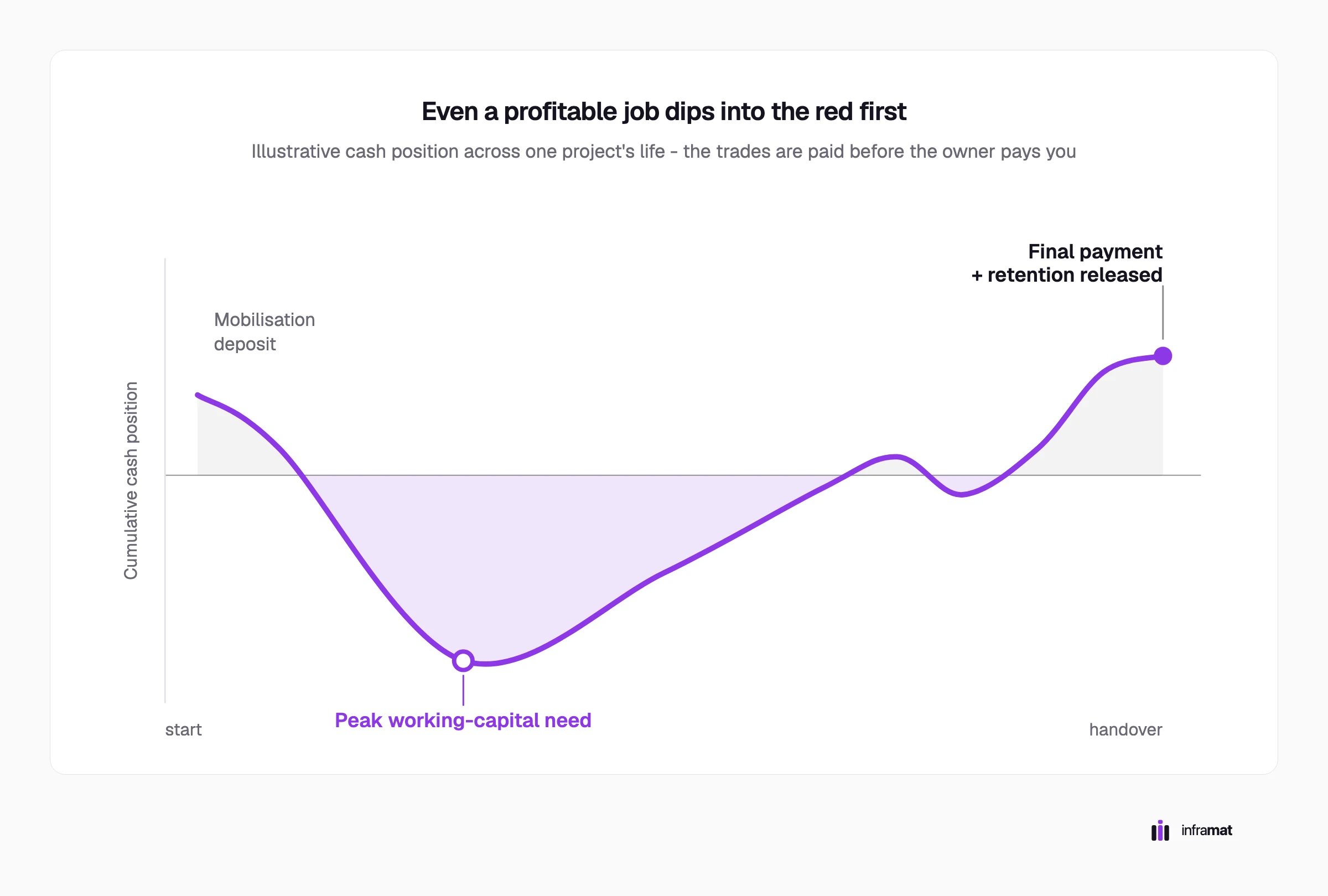
Even a profitable job dips into the red first
Trace the cash on almost any project and it follows the same shape. A mobilisation deposit gets things started, then spending on subs and materials pulls the position steeply negative, and it stays under water for weeks until the owner’s progress payments catch up. The line only climbs back above zero near the end - and the final step up often waits on the released retention.
Why it is structural, not a mistake
None of this signals a mistake. The general contractor sits between an owner who pays slowly and a trade base that must be paid fast, and the float in between is the job.
What is easy to miss is that the subcontractors feel the squeeze even more sharply than the GC does: they carry labour, materials and supervision from day one, well ahead of their own first invoice. That is why “the subs can wait until the owner pays me” is the fastest way to lose the good ones - and why the best contractors quietly pay their trades early to keep them.
“You’re a bank first, a counsellor second, and a contractor last.”
How contractors fund the gap
There is no single trick, but there is a consistent toolkit. The through-line is the same idea from several angles: pull cash forward, push cash out later, and keep a buffer for the difference.
Front-load the billing. Structure the owner’s payments around milestones so money lands before it is spent - design deposit, then permitting and procurement, then mobilisation, then progress draws - and weight the first draw and the schedule of values toward the front of the job.
Take deposits. On smaller residential work, 50% up front is common; on larger jobs, size the first draw to cover materials and the first round of subs, and add a 10-15% mobilisation payment.
Hold a reserve, then add a line. Keep a minimum working-capital reserve before accepting work above a certain size. A credit line smooths the timing noise - but lenders want trading history, so it usually arrives after you have proven the model, not before.
Squeeze supplier terms. Net 30-45 from suppliers, joint cheques to buy materials, and early-payment discounts worth taking - a 2% cut for paying within ten days is real money.
Don’t pay yourself first. Leaving owner distributions in the business as long as possible is how most bootstrapped contractors build the float in the first place.
The clause everyone argues about
Nothing in the debate draws more heat than pay-when-paid - a clause that only obliges the contractor to pay the subcontractor once the owner has paid. On paper it shares the timing risk.
In practice, the contractors who came up as subs push back hard: the subs are more cash-exposed than the GC, so the clause simply relocates the contractor’s financing problem onto the people doing the work; it is unenforceable or outright illegal in many jurisdictions; and it can cloud lien rights. The rough consensus is that it is defensible only on very large trade packages, where the schedule of values is front-loaded to compensate - and that coming from an undercapitalised GC on a small job, it is a warning sign that pushes good subs to raise their price or walk.
Liens follow the same logic. Preserve the right on every job, but do not mistake it for a plan. The real protection is the paper trail - notices, signed change orders, lien waivers, documented draws - that makes getting paid the default and the lien the rare backstop.
“Tell your crew they’ll be paid when the owner pays you, and they’re gone.”
“The lien isn’t your protection - it’s proof your protection already failed.”
The discipline that ties it together
What turns all of this from instinct into a number is a short cash-flow forecast - thirteen weeks is the common horizon. Lay in the expected owner receipts week by week, then every payroll, supplier bill, subcontractor draw, retention holdback and tax payment. The lowest weekly balance is the reserve that project needs.
The same exercise exposes a counter-intuitive trap: two profitable jobs running at once can open a bigger cash gap than one, because their troughs overlap. Growth should be sized to the forecast, not to the pipeline.
The cash gap, in the end, is not a flaw in the business - it is the business. Price it, forecast it, and fund it deliberately, and the timing stops being the thing that sinks an otherwise good job.
Thanks for your attention. See you next time.
Read next

Market sentiment · 7 min read
Is the UAE construction sector cooked? A July 2026 read

Estimating · 9 min read
From drawings to the project price in construction
Procurement · 4 min read
What a concrete block actually costs in Dubai right now

Labour · 6 min read
What construction workers in the UAE actually earn